AI VIDEO / ANALYSIS
YouTube is about to let creators A/B test the video itself
YouTube’s announced video A/B testing moves experimentation beyond titles and thumbnails. Prepare three disciplined cuts, not three unrelated films.
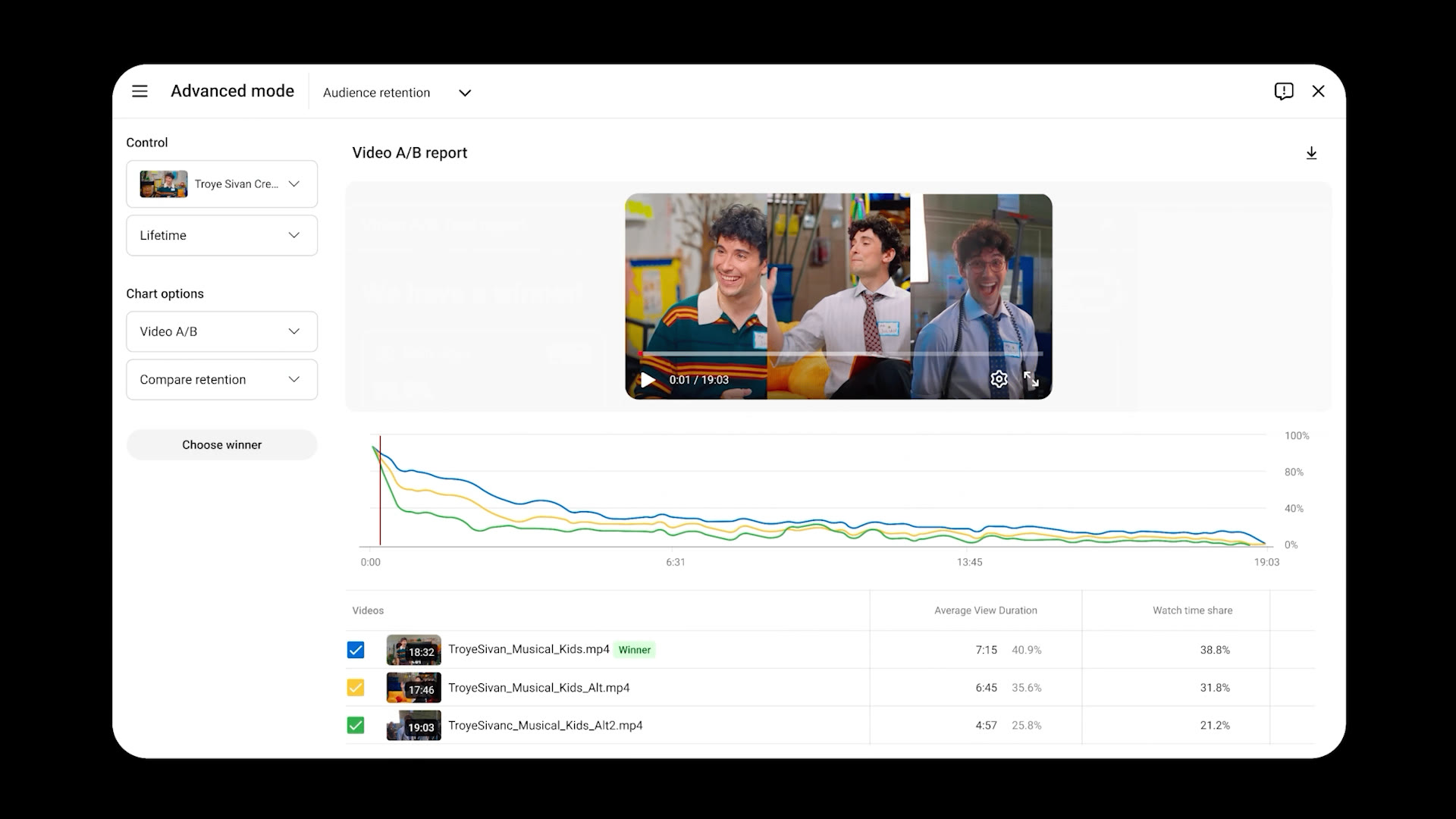
YouTube announced on 23 September that creators will be able to test as many as three cuts of a video to learn which hook holds attention best. The company presented the feature alongside an AI-assisted editing workflow for Shorts and YouTube Create, but described video A/B testing as coming soon. That distinction matters: this is a product announcement, not a feature every channel can use today. [1] [2]
The experiment is moving inside the edit
YouTube Studio already supports experiments around packaging. YouTube says creators have run more than 40 million title and thumbnail tests since that feature launched in 2024. The announced video test goes deeper: three edits can be compared, with a report demonstrating separate retention curves and a selected winner. YouTube has not yet published complete eligibility, rollout or measurement rules for this new test. [1]
This could make opening choices less dependent on instinct alone. It could also produce noisy lessons if every version changes the hook, pacing, structure and duration at once. A useful test isolates one creative question. Otherwise, even a winning cut cannot tell you which decision caused the difference.
Prepare three cuts with one controlled variable
Start with a finished master and duplicate it three times. Keep the promise, subject, thumbnail, title and main body consistent. Change only the opening strategy: Cut A can state the result first, Cut B can begin with the problem, and Cut C can open on the strongest visual proof. Hold the experiment to a fixed opening window, such as the first 20 or 30 seconds.
Name each file by hypothesis rather than by vague labels like final-two. Write one sentence before export: “We expect this opening to retain viewers because…” That note prevents post-result storytelling. If the report eventually exposes both overall and moment-by-moment retention, inspect where the curves separate instead of treating the winner label as the entire lesson.
Use AI for variation, keep judgment human
YouTube’s conversational editor is designed to suggest trims, reorder frames and sync music while allowing manual timeline edits. That makes it a practical assistant for producing controlled alternatives, but the creator still needs to decide what must remain unchanged. Do not let each AI-generated option drift into a different story merely to create variety. [1] [2]
The immediate action is simple: build a reusable opening-test template now. Reserve three sequences, document the single variable and keep a clean master. When video A/B testing reaches your channel, you will be testing an editorial idea rather than improvising three versions at upload time. The valuable output is not only a winning cut; it is a repeatable lesson about what your audience understood fastest.
Sources
- YouTube Blog: New tools to power your creation journey from start to finish · Published 2026-09-23; checked 3 October 2026.
- YouTube Blog: Innovation for the YouTube Era · Published 2026-09-23; checked 3 October 2026.