AI WORKFLOW / PRACTICAL GUIDE
Gemini 4 Neon: test one source-backed brief before trusting the upgrade
Google’s new model targets complex reasoning and knowledge work. A small, repeatable brief test shows whether it helps your actual workflow without letting a strong benchmark stand in for fact-checking.
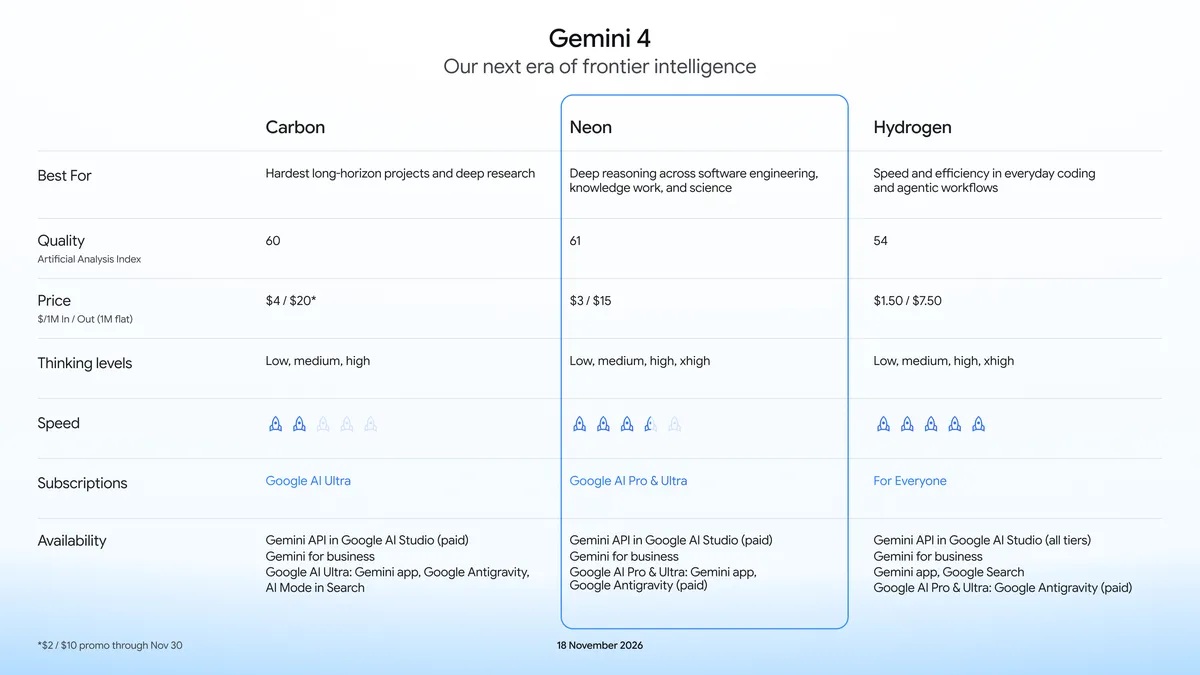
Google introduced Gemini 4 Neon on 18 November 2026 as a model for complex coding, analysis and knowledge work. It sits between Carbon, aimed at the hardest long projects, and Hydrogen, aimed at faster everyday tasks. Google says Neon accepts text, images, audio and video within a context window of up to one million tokens. It is rolling out to paid API and AI Studio users, Gemini for business, and Google AI Pro or Ultra subscribers in the Gemini app and Antigravity, with access varying by channel. That is a product announcement, not proof that a creator’s next brief will be more accurate. WASSAI has not independently tested Neon. [1] [2]
Give it a task you can score
Pick one real but low-stakes assignment: turn three public source documents into a 300-word explainer for a beginner, or compare two product manuals for a short buying guide. Keep the source set, prompt and requested format identical when you run the task in Neon and a model you already use. Ask for a claim-by-claim evidence table with a source name and page or section for each factual statement. Do not add private client files simply to make the test feel realistic. Record how long each run takes and, if you use the API, the tokens and cost shown for the run.
Score both drafts on five questions: Did they answer the brief? Are all quoted numbers traceable? Did either invent a citation? Is the explanation readable for the intended learner? How much editing was needed before publication? Count corrections, not just pleasing sentences. If Neon wins on style but drops a crucial limitation, the extra polish is not an upgrade for that assignment. Repeat with a second example before changing a paid workflow.
Keep current facts outside the model’s memory
Google’s model card says Neon may hallucinate and gives it a March 2026 knowledge cutoff. A November 2026 price, product policy or research result therefore needs a dated primary source supplied or retrieved for this task; a fluent answer alone is not enough. Read the cited passage yourself and check whether it actually supports the sentence. Treat a missing page number, invented source or unexplained number as a failed claim, even when the surrounding brief sounds convincing. [2]
Google reports strong benchmark results and offers four thinking levels for Neon, but benchmarks measure particular setups, not your editorial standard. If the model is available in your account, begin with its default setting and change only one variable at a time. Save the prompt, inputs and corrected final copy so the comparison is repeatable next month. If it is not available yet, prepare the small test set now rather than assuming that a launch-day rollout has reached every account. The best model for a WASSAI-style learning brief is the one whose claims survive the source check with the least repair. [1] [2]
Keep exploring
Sources
- Google: Introducing Gemini 4 Neon · Published 2026-11-18; checked 19 November 2026.
- Google DeepMind: Gemini 4 Neon model card · Published 2026-11-18; checked 19 November 2026.